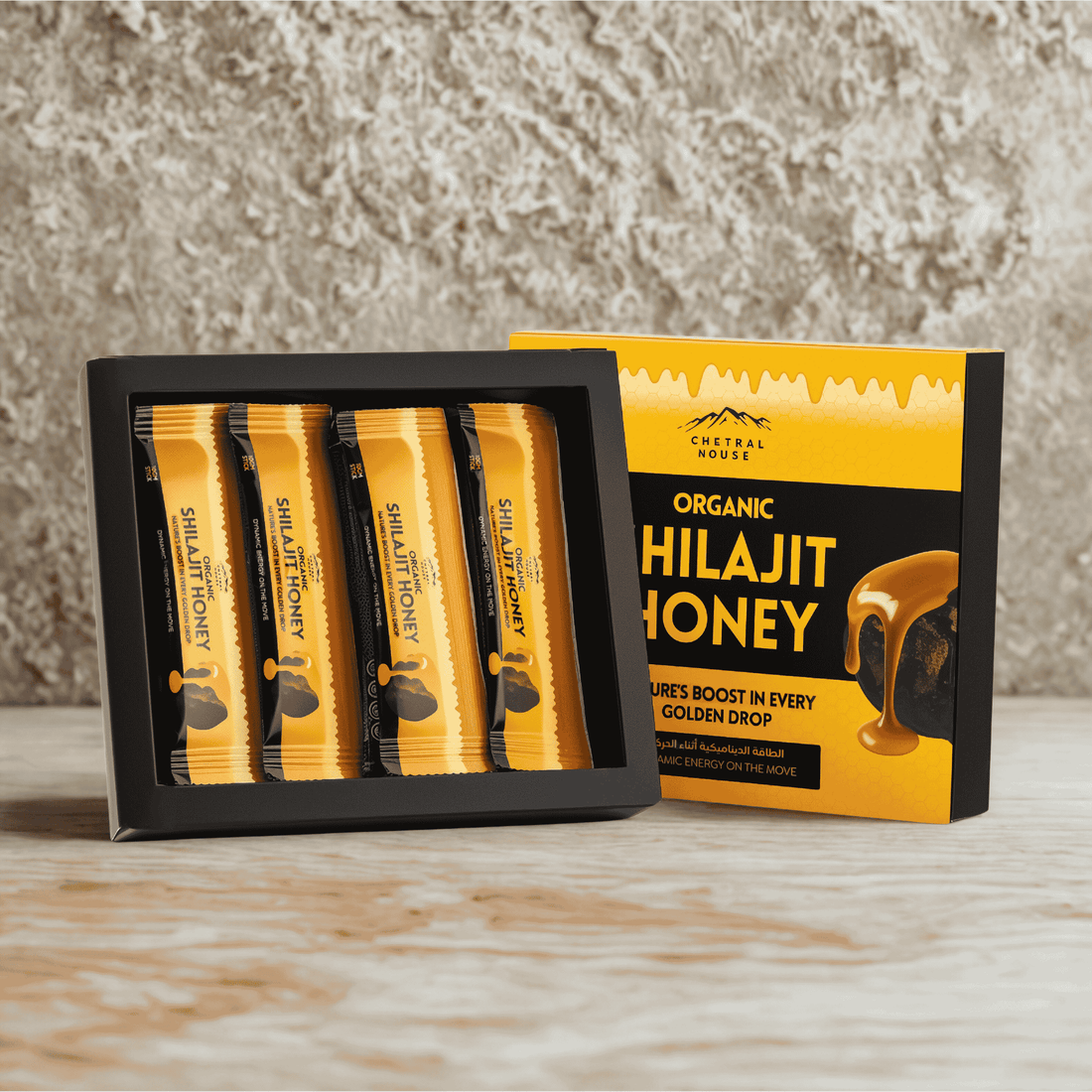
Welcome to the ultimate destination for authentic Honey Shilajit in Pakistan. At Chitral House, we understand that true wellness requires consistency, but consistency can be difficult if the taste or texture of a product is challenging. This is why we created our signature Honey Shilajit (Salajeet) range—a masterful blend of our premium, lab-tested Himalayan Shilajit resin with pure, natural honey.
This collection is designed for those who seek the profound benefits of original Shilajit (Salajeet) without the intense bitterness often associated with pure resin. Whether you are searching for 'Honey Shilajit price in Pakistan,' looking for the 'best Honey Shilajit brand,' or are simply curious about how this natural supplement can boost your energy, you have come to the right place.
At Chitral House, we take pride in being one of the leading Shilajit brands in Pakistan, trusted by thousands of customers from Karachi to Lahore, from Islamabad to Peshawar, and from Quetta to Gilgit-Baltistan. Our commitment to quality, purity, and customer satisfaction has made us the preferred choice for anyone seeking original Himalayan Shilajit.
What is Honey Shilajit? Understanding This Powerful Natural Supplement
Honey Shilajit is a unique formulation that combines two of nature's most potent substances: pure Himalayan Shilajit resin and natural honey. Shilajit, also known as Salajeet or Shilajit resin, is a sticky, tar-like substance that oozes from rocks in high mountain ranges like the Himalayas and Hindu Kush. It is formed over centuries by the slow decomposition of plant matter and is rich in fulvic acid, humic acid, and over 85 essential minerals. Learn more about the combined benefits of shilajit and honey.
Honey, on the other hand, has been used for centuries in traditional medicine systems like Tibb-e-Unani and Ayurveda as a natural sweetener, a healing agent, and a carrier substance (known as 'Anupana') that enhances the absorption of other herbs into the body.
When these two ingredients are combined, the result is a product that is not only delicious but also potentially more effective than Shilajit taken alone. The honey masks the strong, bitter, and smoky taste of pure Shilajit resin, making it accessible to a wider audience, especially those who are new to this powerful supplement.
At Chitral House, our Honey Shilajit is made using 100% original Himalayan Shilajit sourced from the pristine mountains of Gilgit-Baltistan, blended with pure, natural honey. Each batch is lab-tested to ensure it is free from heavy metals, additives, and adulterants. The result is a premium product that delivers all the benefits of authentic Shilajit in a convenient, ready-to-consume sachet format.
Why Choose Honey Shilajit Over Pure Resin? Benefits of This Unique Blend
While pure Shilajit resin is highly potent and preferred by purists, Honey Shilajit offers several distinct advantages that make it the better choice for many users:
| Feature |
Pure Shilajit Resin |
Honey Shilajit (Chitral House) |
| Taste |
Strong, bitter, smoky, and earthy |
Sweet, mild, and pleasant |
| Ease of Use |
Requires measuring, scooping, and mixing |
Pre-measured sachets, ready to consume |
| Portability |
Glass jar; risk of spillage |
Lightweight sachets; ideal for travel |
| Stomach Sensitivity |
May cause mild discomfort for some |
Gentle on the stomach due to honey buffer |
| Absorption |
Standard absorption |
Honey acts as a 'yogavahi' (carrier) to enhance absorption |
| Best For |
Purists, experienced users |
Beginners, travelers, daily users |
Key Takeaway: If you are new to Shilajit or value convenience and taste above all, Honey Shilajit is the ideal choice. If you are an experienced user who prefers the concentrated potency of pure resin, we also offer 10g, 20g, and 30g pure Shilajit resin packs.
Why Chitral House is Pakistan's Most Trusted Shilajit Brand
The market for natural supplements in Pakistan is vast, but authenticity is rare. Many products sold as 'Shilajit' are fake, adulterated, or mixed with harmful substances. At Chitral House, we have built our reputation on transparency, quality, and trust. Here's why thousands of customers across Pakistan choose us:
✅ 100% Original Himalayan Shilajit
Our Shilajit is sourced from the high-altitude regions of Gilgit-Baltistan, specifically from areas above 10,000 feet. This altitude is crucial because the extreme conditions force the plants to produce higher concentrations of bioactive compounds.
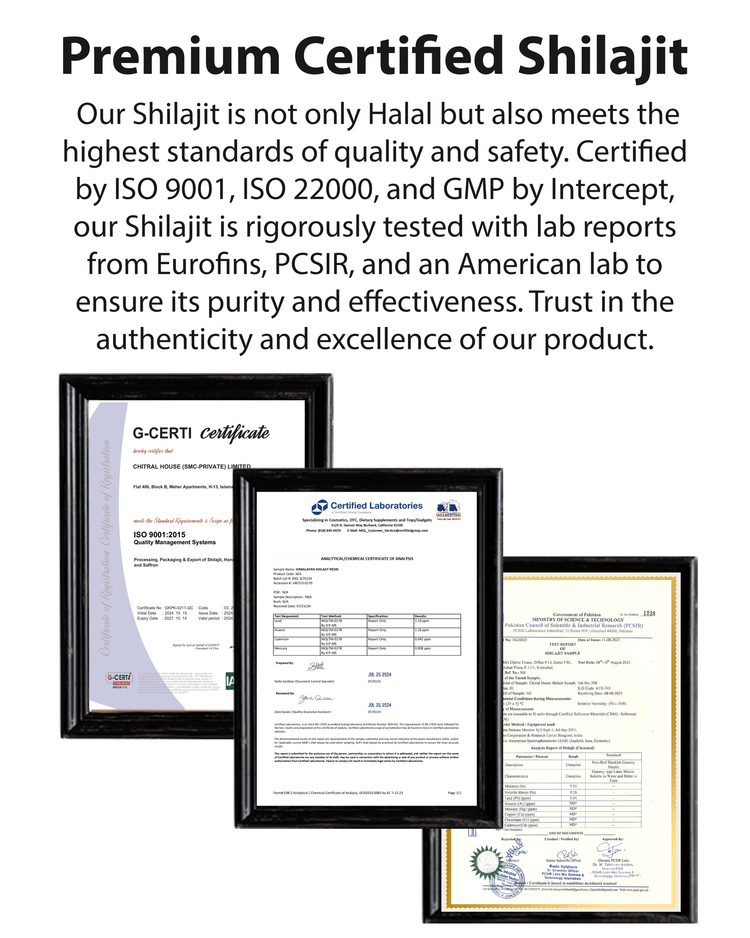
✅ Lab Tested & Certified
Every batch undergoes rigorous third-party lab testing to ensure it is free from heavy metals (lead, mercury, arsenic), adulterants, and harmful bacteria.
✅ High Fulvic Acid Content
Fulvic acid is the key bioactive compound in Shilajit. Our Shilajit is tested to ensure high levels of fulvic acid, guaranteeing potency and effectiveness.
✅ 30-Day Money-Back Guarantee
We are so confident in our products that we offer a 30-day money-back guarantee. If you are not satisfied, simply contact us for a full refund.
✅ Free Shipping Across Pakistan
We offer free shipping on all orders above Rs. 3,000. We deliver to all major cities including Karachi, Lahore, Islamabad, Rawalpindi, Faisalabad, Multan, Peshawar, Quetta, and Gilgit.
✅ Verified Customer Reviews
With hundreds of 5-star reviews from real customers across Pakistan, our reputation speaks for itself.
Comprehensive Honey Shilajit Benefits: What Science Says
Honey Shilajit offers a wide range of health benefits that address the most common health concerns faced by men and women in Pakistan today. Below is a detailed breakdown of the benefits, supported by both traditional knowledge and modern scientific research.
⚡ Natural Energy & Stamina Booster
Shilajit works at the cellular level by improving the function of mitochondria—the powerhouses of your cells. It enhances the production of adenosine triphosphate (ATP), resulting in sustained, jitter-free energy throughout the day.
🧠 Enhanced Cognitive Function & Mental Clarity
The fulvic acid in Shilajit protects the brain from oxidative stress. Regular consumption improves memory, focus, and concentration while reducing mental fatigue.
🛡️ Immune System Support
Shilajit is packed with antioxidants that strengthen the immune system and reduce chronic inflammation, helping the body fight off common infections.
💪 Vitality, Anti-Aging & Testosterone Support
In men, Shilajit supports healthy testosterone levels. In women, it helps balance hormones and improve skin health. It is a natural rejuvenator for all ages.
🥗 Nutritional Support with Essential Minerals
Shilajit is a natural source of over 85 trace minerals including iron, calcium, magnesium, zinc, and potassium—crucial for bone health, muscle function, and overall metabolic health.
🌿 Digestive Health & Gut Support
The honey in our blend provides a soothing effect on the digestive system, while Shilajit promotes the growth of beneficial gut bacteria and reduces inflammation.
Our Honey Shilajit Products: Choose Your Perfect Pack
We offer two convenient pack sizes to suit your needs. Whether you are trying it for the first time or looking for a long-term supply, we have the right option for you. Travelling often? Here is why honey sachets are the best value for travellers.
| Product |
Pack Size |
Key Feature |
Ideal For |
Price (PKR) |
| Honey Shilajit 15 Sachets |
15 x Single Sachets |
Trial / Travel Pack |
Beginners, travelers, 2-week supply |
Rs. 2,000 |
| Honey Shilajit 30 Sachets |
30 x Single Sachets |
Monthly Supply / Best Value |
Daily users, families, best value |
Rs. 3,000 |
How to Use Honey Shilajit Sachets: Simple Daily Routine
Using our Honey Shilajit sachets is incredibly simple, making it the easiest way to incorporate Shilajit into your daily routine in cities like Lahore, Karachi, or Rawalpindi.
-
Direct Consumption: Tear open the sachet and squeeze the paste directly into your mouth. Follow with a sip of water if desired.
-
With Warm Water/Milk: Squeeze the contents into a cup of warm water, milk, or tea. Stir well and drink. This is the traditional method and is especially soothing before bed.
-
Timing: For best results, take one sachet daily. Many prefer to take it on an empty stomach in the morning for an energy boost, or in the evening for recovery.
Storage Instructions: Store in a cool, dry place away from direct sunlight. The 'best before' date is clearly printed on each pack.
Shilajit for Men in Pakistan: Testosterone, Stamina & Vitality
Shilajit has been used for centuries as a natural testosterone booster and aphrodisiac. For men in Pakistan dealing with low energy, reduced stamina, or age-related decline in vitality, Honey Shilajit offers a natural solution. Read our complete guide to shilajit for men's health.
Clinical studies have shown that Shilajit can significantly increase total testosterone levels in healthy men. Benefits include:
- Improved libido and sexual health
- Increased muscle strength and faster recovery after exercise
- Enhanced energy and stamina
- Better mood and confidence
- Support for healthy sperm count and quality
Many of our male customers from Karachi, Lahore, and Islamabad report noticeable improvements in energy and vitality within the first few weeks of consistent use.
Shilajit for Women in Pakistan: Energy, Hormones & Skin Health
While often marketed for men, Shilajit offers significant benefits for women as well. Women in Pakistan facing hormonal imbalances, fatigue, or skin concerns can greatly benefit from regular use of Honey Shilajit.
-
Hormonal Balance: Shilajit helps regulate hormones and may reduce symptoms associated with PMS and menopause.
-
Iron Supplementation: Rich in natural iron, Shilajit can help combat anemia and fatigue, common issues among women.
-
Skin Health: The antioxidants in Shilajit promote collagen production and protect against oxidative stress, leading to healthier, more radiant skin.
-
Energy & Vitality: Sustained energy without jitters or crashes.
Scientific Research: What Studies Say About Shilajit
Modern science is catching up to what traditional medicine has known for centuries. Here are some key findings from peer-reviewed studies on Shilajit:
📚 Testosterone Study (2021)
A study published in the Journal of Ethnopharmacology found that healthy men who took Shilajit for 90 days showed a significant increase in total testosterone levels compared to the placebo group.
📚 Cognitive Function Study (2020)
Research in the International Journal of Alzheimer's Disease highlighted Shilajit's potential to improve cognitive function and protect against neurodegenerative diseases due to its high fulvic acid content.
📚 Energy & Mitochondrial Function
Multiple studies have confirmed that Shilajit enhances mitochondrial function and ATP production, explaining its profound effects on energy and stamina.
📚 Heavy Metal Chelation
Research shows that the fulvic acid in Shilajit acts as a natural chelator, helping the body eliminate heavy metals and toxins.
What Our Customers Say: Real Honey Shilajit Reviews from Pakistan
Don't just take our word for it. Here's what real customers across Pakistan have to say about our Honey Shilajit:
★★★★★
'Innovative product easy to use specially in Ramazan. Overall good quality recommended for use.'
— Verified Buyer, Pakistan
★★★★★
'Its helps me in daily busy routine. Helps to boost energy and give stamina.'
— TALHA, Verified Buyer
★★★★☆
'Good Taste & Powerful. Highly recommended for everyone.'
— Zeeshan Rana, Verified Buyer
★★★★★
'Very good quality. That's perfect duet.'
— Syed Ahsan Ali, Verified Buyer
Frequently Asked Questions (FAQs) About Honey Shilajit
What is the price of Honey Shilajit in Pakistan?
The Honey Shilajit price in Pakistan depends on the pack size. Our 15-sachet pack is available for Rs. 2,000, while the 30-sachet pack offers the best value at Rs. 3,000. These prices are competitive for lab-tested, imported-quality Himalayan Shilajit blended with pure honey.
What is the best time to take Honey Shilajit?
For energy and focus, take it in the morning on an empty stomach. If you are using it for recovery and deep sleep, taking it in the evening with warm milk is highly effective.
Is Honey Shilajit safe for daily use?
Yes, when consumed from a trusted source like Chitral House, it is safe for daily use. We recommend taking a break for 1-2 days a week to allow the body to reset, but many users take it daily without any issues.
What is the difference between Pure Shilajit Resin and Honey Shilajit?
Pure Shilajit Resin is 100% concentrated Shilajit and has a strong, bitter taste. Honey Shilajit is a blend of the same resin with natural honey. It is milder in taste, easier to consume, and comes in pre-measured sachets for convenience.
Where can I buy authentic Honey Shilajit online in Pakistan?
You can buy authentic Honey Shilajit online in Pakistan directly from the Chitral House website. We offer secure payment options and fast, reliable delivery to all major cities including Karachi, Lahore, Islamabad, Faisalabad, Rawalpindi, Multan, Gujranwala, Peshawar, Quetta, and all other locations.
Does Honey Shilajit expire?
Yes, our Honey Shilajit has a shelf life of up to 24 months when stored in a cool, dry place away from direct sunlight. The 'best before' date is clearly printed on each pack.
Is Honey Shilajit good for women?
Absolutely. While often marketed for men, Shilajit offers significant benefits for women as well, including improved energy, hormonal balance, iron supplementation, and enhanced skin health.
How do I know the Shilajit is original?
We stand by our product with a 30-day money-back guarantee. Our Shilajit is lab-tested for purity and potency. If you have any concerns, our customer service team is available to assist you. See our guide on how to identify original vs fake shilajit.
Can I take Honey Shilajit with other medications?
If you are taking prescription medications, especially for diabetes, blood pressure, or thyroid conditions, we recommend consulting with your healthcare provider before starting Shilajit.
What is the shipping time for Honey Shilajit in Pakistan?
We offer free shipping on orders above Rs. 3,000. Delivery typically takes 2-5 business days for major cities and 5-7 business days for remote areas across Pakistan.
Experience the Chitral House Difference: Order Your Honey Shilajit Today
Your search for the best Honey Shilajit in Pakistan ends here. We invite you to explore our collection and choose the pack that fits your lifestyle. Whether you are a seasoned user or a curious beginner, our Honey Shilajit offers the perfect balance of potency and taste.
At Chitral House, we are committed to providing you with the highest quality original Himalayan Shilajit available in Pakistan. With our lab-tested purity, 30-day money-back guarantee, and free shipping across Pakistan, you can shop with confidence.